
Curriculum Statement
Curriculum Intent
At Harbour School Dorset we believe that all children are entitled to an accessible education that supports students to reach their potential offering them opportunities to grow as individuals as well as learners.
The school and its curriculum are designed to serve children and young people who live with autism and trauma and whose emotional needs cannot be met in a mainstream setting. We prioritise our learners’ personal development, effective communication and functional learning offer to address differences and gaps in their understanding, skills and knowledge.
All students at HSD have an Educational Health and Care plan based on a diagnosis of ASC (Autism Spectrum Condition) and SEMH (Social Emotional Mental Health) needs. These needs impact on individual development and, to differing extents, shapes the nature of the child’s education. Education for these children should reflect the unique presentation of each individual and we believe these differences merit a specific approach whereby skills can be fostered to maximum effect, rather than trying to fit the child into a ‘normative’ model of development.
The Curriculum is designed to make our learners lives better by giving them the skills, qualifications and confidence they need to be successful in their future education, employment or training.
The core intent of the HSD curriculum is to support each student in developing independence, to encourage a positive sense of self, and to promote a positive attitude to learning so that they can access learning fully.
Within these broad principles, we recognise that we have a responsibility towards a wide range of learners and that certain principles must underpin our curriculum intent and implementation.
These principles are:
- the inclusion of all pupils
- recognition that pupils acquire understanding at different rates and in different ways
- that opportunities must be given for pupils to organise information and to generalise and practice new skills
- that experiential learning is vital for all pupils.
- recognition that there is a social and emotional aspect to all pupils’ learning
- the recognition and celebration of multi-cultural diversity
- the promotion of pupil self-esteem and resilience
- the meeting of legal obligations.
The curriculum is delivered through 3 strands; personal development; Effective Communication; Functional Learning as detailed below:
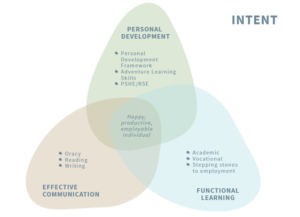
Our school values the input of its pupils, parents and the local community with regards to the planning and delivery of the curriculum. We believe pupils get a well-rounded education if everyone is involved in shaping it.
We engage with the wider community by ensuring there are opportunities for pupils to participate in community projects, e.g. HSD community café.
LEGISLATION AND GUIDANCE
This Curriculum Statement reflects the requirements for academies to provide a broad and balanced curriculum as per the Academies Act 2010, and the National Curriculum Programmes of Study, which the school has chosen to follow where appropriate to meet the needs of individuals.
It also reflects requirements for inclusion and equality as set out in the Special Educational Needs and Disability Code of Practice 2014 and Equality Act 2010, and refers to curriculum-related expectations of governing boards set out in the Department for Education’s Governance Handbook.
It complies with our funding agreement and articles of association.
INCLUSION
As a Special Free School, all pupils will have Special Educational Needs and/or Disabilities and the majority will have an Education and Health Care Plan (EHCP). Teachers set high expectations for all pupils. They will use appropriate assessments contextualised with Goals and Progress (GaPs) documents to set ambitious targets and plan challenging work matched to need for all individuals and groups, including:
- More able pupils
- Pupils with low prior attainment
- Pupils with a specific learning disability
- Pupils from disadvantaged backgrounds
- Pupils with English as an additional language (EAL)
Teachers will plan lessons so that all pupils have the opportunity to study every National Curriculum subject, wherever appropriate, and ensure that effective support / interventions are in place in order that barriers to achievement are removed or reduced.
Teachers will also take account of the needs of pupils whose first language is not English. Lessons will be planned so that teaching opportunities help pupils to develop their English, and to support pupils to take part in all subjects.
Our curriculum has been designed for a range of learners, providing equal opportunities for all – by doing this, pupils will benefit in the following ways:
- Learning how to lead safe, healthy and fulfilling lives
- Understanding that failure is part of the road to success
- Being rewarded for academic successes
- Being supported with their next stages in education or training and feeling prepared for life after school
- Becoming responsible individuals who contribute to community living and the environment
- Achieving to the best of their ability
- Acquiring a wealth of knowledge and experience
- Becoming critical thinkers
- Finding a sense of belonging within the school and its community
- Learning how to cooperate with their peers and respect one another inside and outside of the classroom
Tiers of Provision
Tiers of Provision
We intend to deliver the curriculum via a tiered approach, and the school has an internal Child Centred Review (PCR) panel to refer students from one tier to another:
Tier 1: Universal provision – Classroom-based learning differentiated according to student’s academic level, personal needs and learning preferences. Teachers use different learning resources and methods to teach core content. Classes are small (usually up t to 8 students) with a high staff to student ratio (Typically 3:8). Subjects taught are shown below.
Tier 2: Boost Provision – Classroom-based learning with extra intervention as required. Students at HSD have a range of additional needs and access small group or one-to-one interventions to meet their academic, social/emotional, medical or individual needs e.g. ELSA support, Sensory support, English/maths interventions, speech and language, SEMH support etc.
Tier 3: Stretched Provision – Some students find it hard to access the universal and targeted provision listed above alongside their peers. These students have individual curriculums delivered in school through class-based learning, outdoor learning provided by HSD and some access alternative provision delivered off-site. These pupils also work on the Belonging Curriculum shown below as they typically have SEMH needs. The staff to student ratio is higher for these students as key adults are important to their progress.
Tier 4: Bespoke provision – Some students need an entirely bespoke curriculum to meet their significant needs. Students are educated off-site and access a provision that is individual. Most of these students access alternative provision from an HSD approved list.
Curriculum Design

Years 5, 6 and 7 Cornerstones Curriculum
Pupils in Years 5, 6 and 7 follow a topic-based curriculum that allows for individual needs to be met in a creative learning environment and prepares them for the demands of the next stage. There is a strong emphasis on shared outdoor learning opportunities, explicit teaching of life-skills and promoting play that enable pupils to develop self-confidence and an understanding of different environments and social situations. Pupils in these year groups have a single teacher/tutor who maintains responsibility for all aspects of their provision.
The students receive a curriculum that meets individual need as well as their profile needs. We map planning to the National Curriculum, and this is the basis of our Year 5, Year 6 and Year 7 curriculum.
Years 8 and 9 Transitions Curriculum
Our Year 8 and Year 9 curriculum moves to a secondary model based on National Curriculum objectives in which subjects are taught discretely and there is greater emphasis on transition; pupils are required to move between learning environments and/or teaching staff, thereby being supported to generalise their developing social skills. Pupils in Year 8 have a single teacher who maintains responsibility for all aspects of their provision. Year 9 have a single tutor who is responsible for all pupils’ provision that sits outside specific subject teaching. Pupils in these year groups have access to Adventure Learning for 1 day per fortnight to develop personal skills.
Years 10 and 11 Options Curriculum
When pupils reach Year 10 and Year 11, there are flexible academic and vocational pathways that include Functional Skills; GCSEs; Life and Living Skills; and a range of Vocational opportunities. The aim is for students to leave HSD with at least 5 recognised qualifications – maths. English and 3 other academic or vocational qualifications. Students access work experience appropriate to their needs and are sign-posted to Post 16 opportunities within and beyond HSD.
Post 16 (Year 12 and 13) Choices Curriculum
In Post 16 our offer is designed to be the stepping stone to employment. In Year 12 students follow a vocational pathway with a clear focus on ensuring students work towards Maths and English qualifications at GCSE Grade 4/Functional Skills Level2 if they have not gained this already. Students choose 1 or 2 vocational subjects and also study for a Work Skills BTEC. In Year 13 the aim is to find work placements for up to 3 days a week and complete Work Skills BTEC level 2.
Enrichment Clubs
Pupils based at HSD engages with an Enrichment Club weekly on a Friday morning. The clubs are delivered by Class Teachers and Learning Mentors and offer extended enrichment opportunities for pupils to make progress towards their personal development targets.
Additionally, these clubs offer students recognition for their learning through the AQA Unit Award Scheme Unit Award Scheme (UAS). The UAS is invaluable as it is an important pathway for our students to receive accreditation for their achievements.
Adventure Learning
When we listen to our parents and pupils, most of them tell us that typical mainstream physical education has historically been cause for anxiety. This has in some cases been considered the reasons for non-attendance or reduced timetables in the past. At HSD, we know how important exercise is for our well-being and resilience. Adventure learning is a key part of our curriculum. We have our own team of outdoor education experts that are experienced in adapting experiences to meet the needs of pupils. This can be very motivating for those pupils who struggle with PE and learning in the classroom.
Adventure Learning provides a broad menu of opportunities for pupils to experience the wider world, take risks and develop creativity, curiosity, new interests and aspirations to become confident, independent learners. Qualified staff will use the natural world to stimulate imagination through a range of outdoor activities.
The adventure learning curriculum has a clear pathway of skills and experiences from Year 5 up to post 16. In years 5-7 students have an afternoon a week and provision is largely on-site in our Forest School area. In Year 8 and 9 students have one full day per fortnight dedicated to off-site activities such as mountain biking, kayaking, climbing etc. There is an option from year 10-Post 16 for students to gain a Sports NCFE qualification in outdoor learning.
Mentoring
All pupils have a link mentor as part of their class team, who acts as advocate, celebrate success and discuss problems and is the first point of contact for families and other professionals. Mentors are responsible for setting Personal Development Targets for pupils and supporting/reviewing progress towards these.
Mentoring is an ongoing process and Learning Mentors work with students in every lesson to promote positive social and learning behaviours (informed by the Personal development Framework), and subsequent progress towards individual personal development targets.
Interventions
At HSD, interventions are delivered with either a Personalised Learning focus or a Therapeutic focus. These interventions are managed by the SENCo and Curriculum Leadership Team and delivered by teachers and Learning Mentors as well as external services where appropriate.
The Family Liaison Officer and Designated Safeguarding Lead support school staff to work effectively within multi-disciplinary teams.
High-quality multi-agency work is of high importance, and the school recognises that it is essential to work collaboratively to provide each pupil with a personalised provision that addresses their social, emotional, educational and health needs.
Life Skills and Community
Life Skills
Life Skills are taught both discretely and embedded broadly across the HSD curriculum. The organisation of Life Skills coverage at HSD can be seen in Figure 5.
Work Experience (IAG)
Information, Advice and Guidance (IAG) forms an integral part of our curriculum in KS 3, 4 and 5. Students identify key milestones with our IAG Advisor that reflect developing interests, aspirations and goals, identifies curriculum choices and destination-focused planning for the next stage of education or training, community opportunities and independent living. IAG continues through work experience, interviews and beyond school when graduates face the challenges of the next stage.
SMSC and British Values
As a Trust, we are committed to welcoming pupils and families of all faiths and beliefs and encouraging them to respect fundamental British values. Through our Admissions Policy, and in line with the SEND Code of Practice, we make it clear that we will admit pupils on the basis that the academy is able to meet the needs as stated in our funding agreement. Religious Education themes and topics are included in all three stages of the HSD Curriculum Progression and are defined in the HSD Rights Respecting Framework. Pupils of any faith and those of no faith are encouraged to value everyone and their beliefs equally. Assembly times focus on celebration, reflection, appreciation and the worthiness of all members of the community.
Through a broad curriculum, we actively promote fundamental British values (democracy, the rule of law, individual liberty, mutual respect and tolerance of those of different faiths and beliefs) by way of cross-curricular themes in the lower school and through PSD in the upper school. We actively challenge pupils, staff or parents expressing opinions contrary to British values and seek to promote a positive approach to pupils’ spiritual, moral, social and cultural education. We carry out an annual curriculum audit to ensure that it consistently prepares pupils for life in modern Britain.
Sex and Relationships Education (see RSE Policy)
This is delivered through the thematic curriculum, informed by The PSHE Association and ASDAN PSD, at a level appropriate to individuals and groups. We work closely with a range of agencies, including health colleagues, who provide specialist input and support.
Curriculum Impact
Family Fridays
Any child with additional needs requires a support network that is cohesive; therefore, we believe it is imperative to work in close partnership with parents/carers and families. Often children have highly complex needs and may require considerable levels of support for everyday life. A diagnosis of autism affects the whole family; close work between home and school provides the best all-round support, as well as facilitating the sharing of good practice and successes across both environments.
Family Fridays also supported the effective review of Core Skills PLGs, informed by pupils’ EHCPs. This review of previous targets, and setting of new targets is done during Family Fridays, in full consultation with pupils and parents, every half-term.
Accreditation
All learning outcomes, including enrichment, are accredited through GCSE / BTEC / City & Guilds / ABC/ ASDAN/ AQA Unit Awards and Functional Skills.


